The results of the 2011 Computer-Based Writing Assessment conducted by the National Assessment of Educational Progress (NAEP) were released today. In this new national writing assessment sample, 24,100 eighth-graders and 28,100 twelfth-graders engaged with writing tasks and composed their responses on computer. The assessment measured students’ ability to write on the computer for specific purpose or audiences, and the extent to which they use commonly available word-processing tools when composing their writing. Note this was not an automated essay scoring test – just the administration of the writing assessment using computers.
TopLine results:
- 80% of eighth-graders and 79% of twelfth-graders performed at or above the Basic level in writing in 2011.
- 27% of students at both grades 8 and 12 performed at or above the Proficient level in writing.
Students were given two tasks with a half an hour to complete each, and each tasks measured one of three purposes in typical writing situations: to persuade, to explain, or to convey experience. The assessments combined written, multimedia audio or video prompts, and were designed for real life writing that could easily be found in common workplace or academic settings.
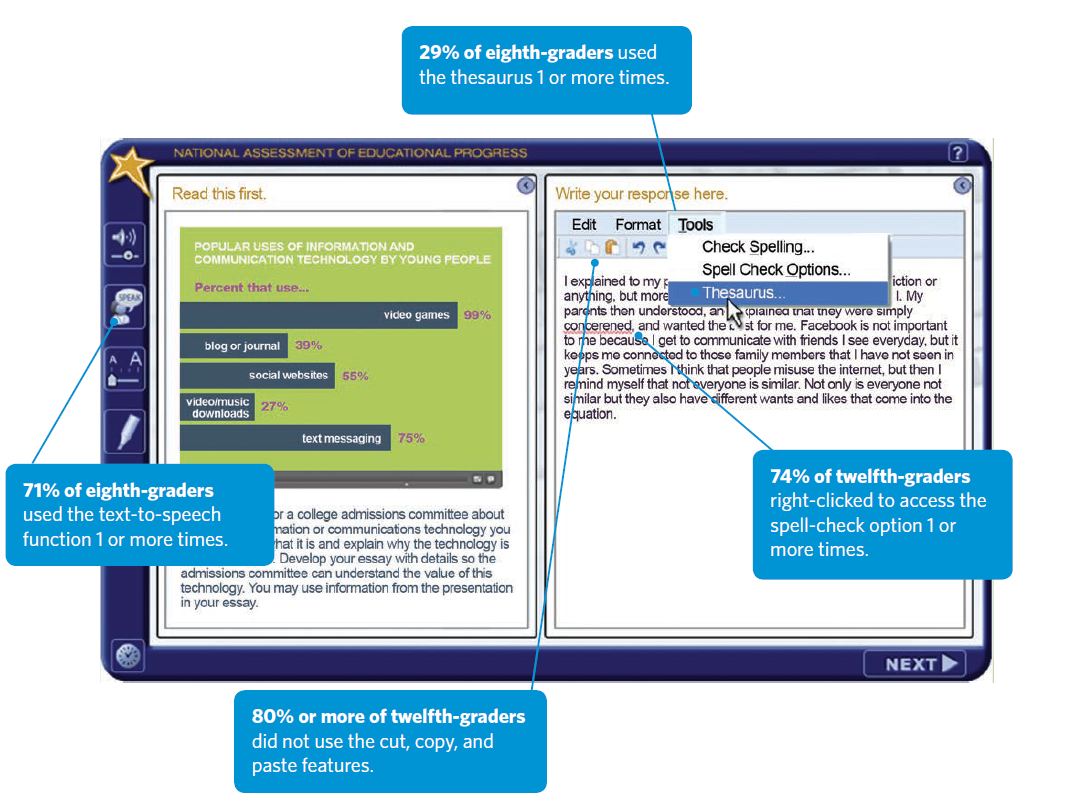
Scoring guides were developed for human scorers and the assessments were graded as rough drafts. Students were allowed some basic formatting and editing tools, such as backspace, cut, copy, paste, bold, spell-check, and thesaurus. Results came across in three achievement levels: Basic, Proficient, and Advanced, with 75% of 8th and 12th grade students performing at or above the Basic achievement level.
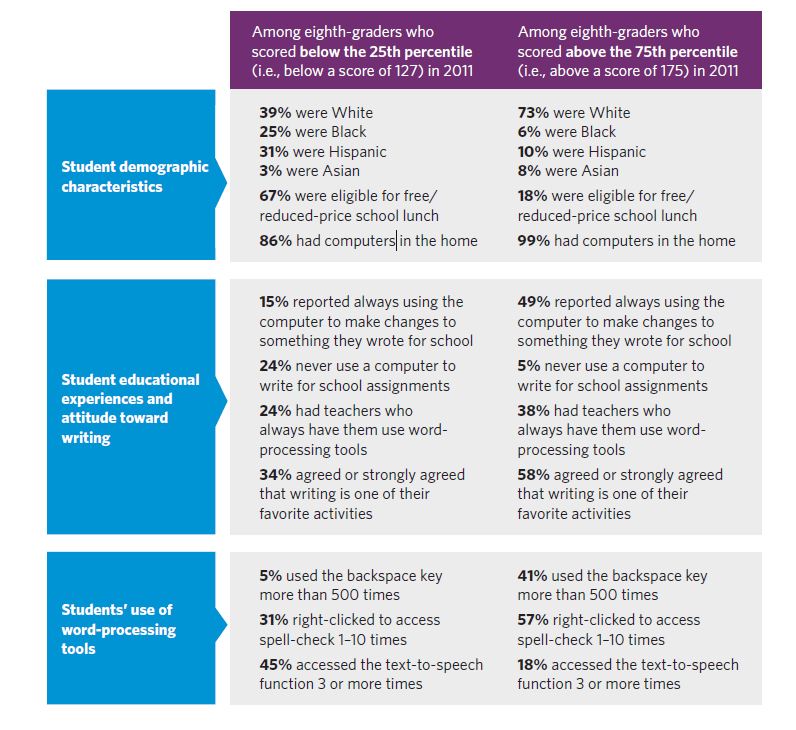
Despite concerns that the digital medium would penalize students that did not have regular access to computers, the patterns of differences between pen-and-paper assessments and computer-based assessments seem to stay consistent. The computer does not seem to penalize or give advantage to any one group compared to another, and higher-achieving students seem to do better on writing assessments whether or not they are computer-based.
The assessment included a questionnaire for teachers. One interesting finding is that a total of 44% of students had teachers who reported that they asked students to use computers for drafting and revising very often or always. Students whose teachers more frequently asked them to use the computer to draft and revise their writing scored higher than those whose teachers did so less frequently